




Sea-level rise
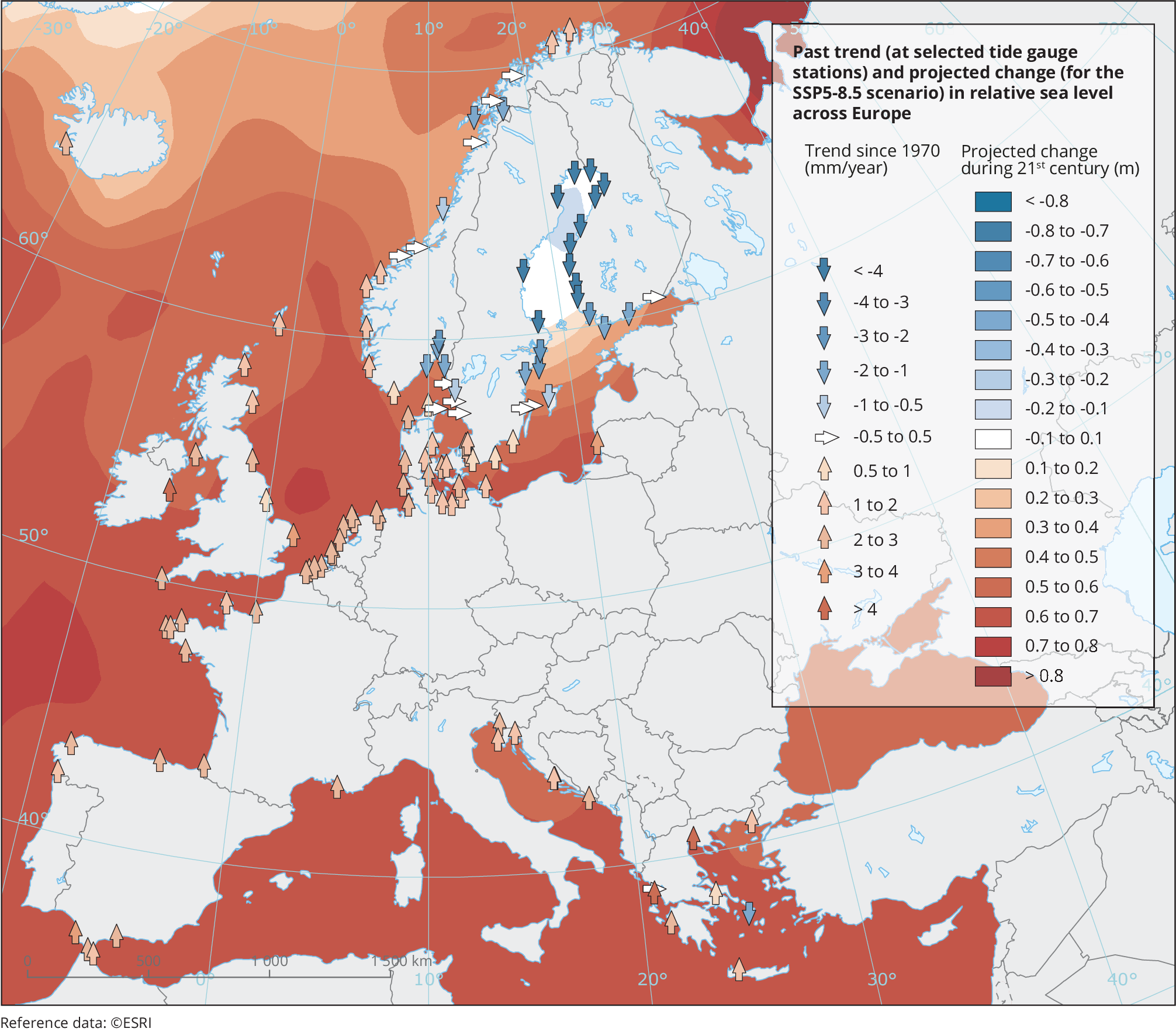
On August 29 2022, the paper 'Greenland ice sheet climate disequilibrium and committed sea-level rise' was published in nature climate change. It found that the Greenland ice imbalance commits us to at least 274 ± 68 mm Sea-Level Rise (SLR) from 59 ± 15 × 103 km2 ice retreat, equivalent to a 3.3 ± 0.9% volume loss, regardless of twenty-first-century climate pathways. In simple terms indicating that a minimum of 27cm of global sea level rise is likely irrespective of climate action.
In 2021 The Proceedings of the National Academy of Sciences (PNAS) published a paper entitled 'Critical slowing down suggests that the western Greenland Ice Sheet is close to a tipping point' indicating that in response to anthropogenic global warming a crucial nonlinear mechanism or positive melt-elevation feedback will create a tipping point for the Greenland Ice Sheet. This feedback occurs where melting reduces the height of an ice sheet, in turn exposing the ice sheet surface to warmer temperatures, which further accelerates melting.
In 2020 a report based on the Arctic Report Card (ARC), showed that between September 2018 and August 2019, the Greenland Ice Sheet set a record for ice loss (532 ± 58 billion metric tons). Between September 2019 and August 2020, the rate of ice loss from the Greenland Ice Sheet was much lower (293 ± 66 billion metric tons), but still above the 2002–2020 average measured by GRACE. Average ice loss for Greenland over the full 18-year record was 268 ± 14 billion metric tons per year.
Related articles on Designing Buildings
Featured articles
Check out some of the best features and news from Designing Buildings as well as key stories from around the web.

Government approach could undermine delivery and regeneration.
World's first mass timber data centre.

The overlooked environmental aspect of data centre development.
Introduction to radon awareness

New technical information sheet published by CIOB.

Updated supplier guide can help electrical contractors engage with NHP.

CIAT confirm the winners of the 2026 architectural technology awards.

Government launches a one stop shop for flood preparedness.

Sir Edwin Lutyens: Britain's greatest architect? Book review.

CIOB publishes free template to help assess and manage risks.
ECA's reflections on Party Conference season

Burnham wants to be confident of winning before asking for a fresh mandate.
New Chief Construction and Scientific Adviser

Sergio Cavalaro, Professor of Infrastructure Systems at Loughborough University.
Building safety levy for England

CIAT publish estimator tool for members.

Water sector faces a growing crisis that could slow the delivery of vital infrastructure.